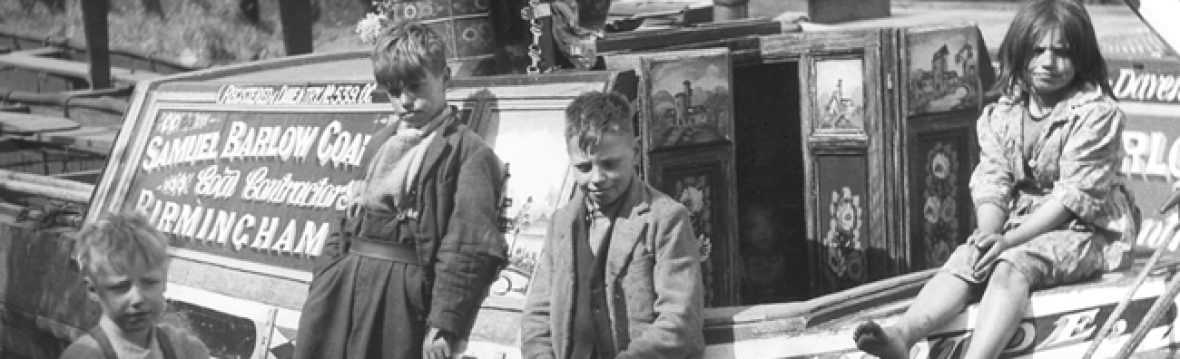

At once a social and industrial landscape, Hawkesbury presented the opportunity for Robert to encounter a singularly uncommon scene of mid-century English industrial life.
It was frequented not only by the working man, who navigated his narrow boat with loads of coal down the Oxford Canal, but also by his pet dog, wife and children too. As these images repeatedly belie; this was a working life that demanded one lived on the job – along with the entire family.
The hardiness and genial nature synonymous with rural communities is perhaps a cliché, but these traits are only too apparent in these portraits. Transposed to the working of the inland waterways, the sense of a tightly-knit, extended family still prevailed.
The images are neither sentimental nor bucolic. They depict an arduous existence with profound empathy. A viewer of Robert’s work would be forgiven for assuming that the waterways at this time were being run completely by minors! The compositions are certainly picturesque, but we must remember this is ostensibly child labour.
The people were bonded by daily tasks that required strength and cooperation, and eventually by the inevitable marriages that ensued after their encounter and re-encounter, as they worked locks or waited in line to draw water. There was also ineffable awareness that they were marked out as different by the ‘landlubbers’ they ultimately served.
Although the summer brought out the best in this area, both in terms of newly painted narrowboat livery and summer frocks, Robert was certainly not a fair-weather photographer, he has left us with some beguiling scenes of a snowbound Hawkesbury, with cooling towers belching out over unpopulated polar scenes where the tow-path is under snowdrifts and canal surface is iced over.
 robertlongden.photo